



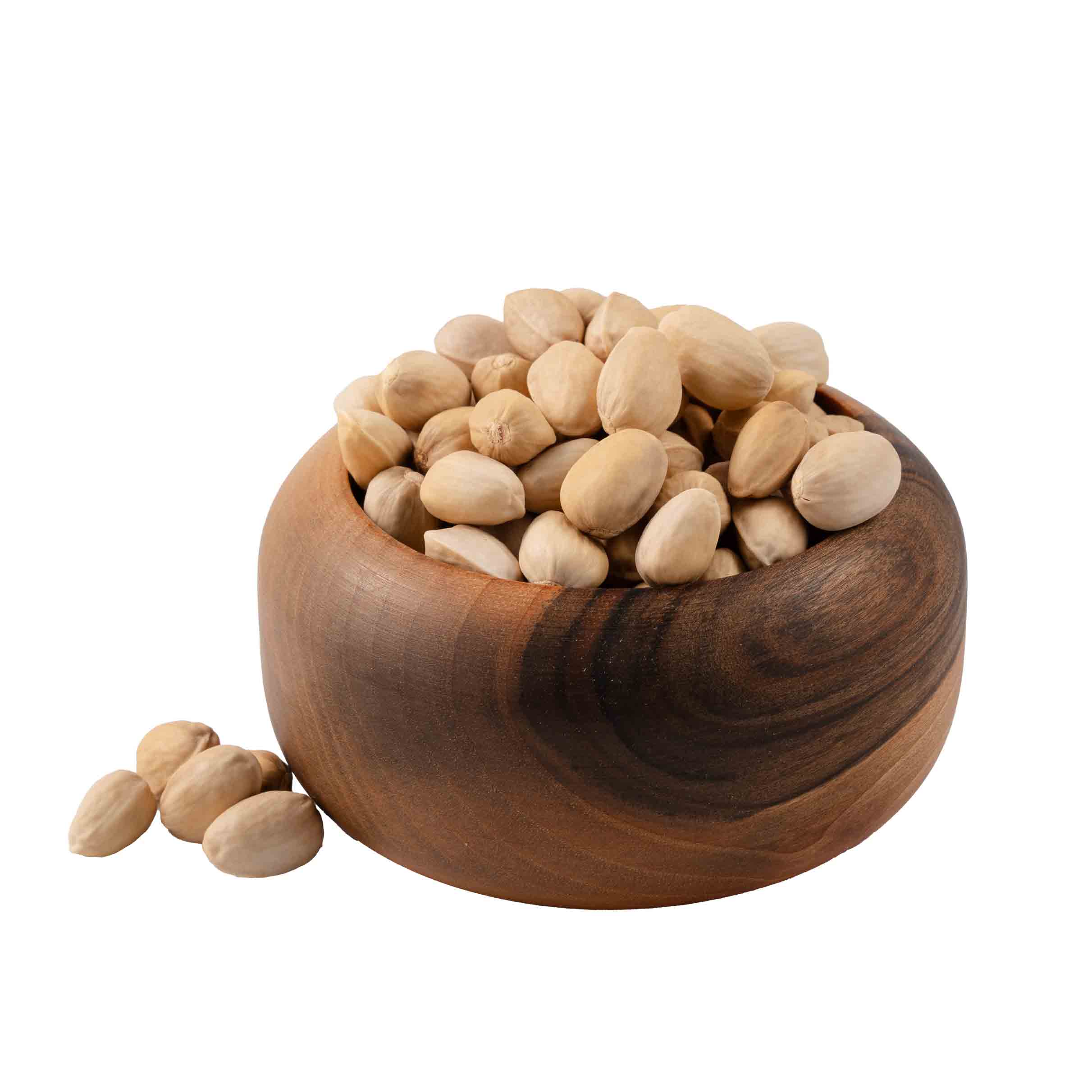

Closed‑shell pistachio refers to a pistachio whose hard shell has not naturally opened despite the kernel being fully matured. This type of pistachio has no difference in internal quality compared to open‑shell pistachios, and its kernel is completely healthy, ripe, and has high nutritional value. The closed shell of pistachios is usually related to genetic factors, climatic conditions, irrigation levels, and the pistachio variety.
In terms of appearance, closed‑shell pistachios have a completely closed, smooth shell without any cracks. This feature makes this type of pistachio less commonly used for direct consumption as a snack nut; however, it has high value in the nut‑processing industry. Closed‑shell pistachios are usually used for industrial cracking, the production of pistachio kernels, pistachio slivers, pistachio kernel splits, and other pistachio derivatives.
One of the important advantages of closed‑shell pistachios is the natural protection provided by the shell for the inner kernel. Because the shell remains completely closed, the pistachio kernel is largely protected against environmental contamination, dust, and moisture. This can be considered an advantage for short‑term storage, especially when the pistachios are stored under suitable conditions.
In terms of taste, the kernel obtained from closed‑shell pistachios is completely similar to that of open‑shell pistachios; it has a natural, slightly sweet, and pleasant flavor. After cracking the shell, the kernel separates well, and if processed properly, it will have high quality for various uses.
The main application of closed‑shell pistachios is in processing industries. Kernel‑extraction workshops and nut‑processing units purchase this type of pistachio as a raw material so that after mechanical cracking, the pistachio kernels can be prepared for sale or for use in confectionery industries. Closed‑shell pistachios also play an important role in the production of pistachio slivers, pistachio kernel splits, and export‑grade pistachio kernels.
From an economic perspective, closed‑shell pistachios usually have a lower price than open‑shell pistachios, which makes them cost‑effective for industrial consumers. However, the final product quality depends entirely on proper processing and suitable equipment.
Storage of closed‑shell pistachios is relatively easier than storing pistachio kernels, because the hard shell acts as a protective layer. Nevertheless, proper storage principles must still be observed in order to prevent mold growth or quality deterioration.
Reviews
There are no reviews yet.